Posts

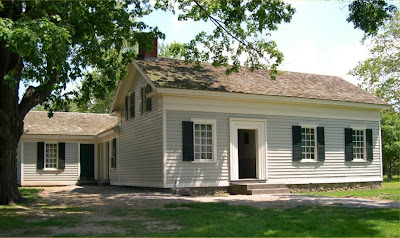
William Holmes McGuffey Birthplace (formerly known as McGuffey Birthplace)

Image
If you read the second chapter / blog of this Greenfield Village collection you will remember reading the following: The year was 1914, and Clara Ford, wife of Henry, watched children play one day as they made their way home from school. A childhood rhyme suddenly came to her, and she said it aloud: 'Hear the children gaily shout, "Half past four and school is out!" ' Henry and Clara both thought the rhyme came from one of the W illiam McGuffey Eclectic Readers, first published in 1836. After a futile search to find which Reader it came from, and through it all amassing a rather large and complete collection of the 145 different editions, he found he had a penchant for collecting. He already had a rather large collection of clocks and watches, which he loved to tinker with as a child. And, he had accumulated objects of his hero, Thomas Edison. So the McGuffey Readers were just another extension of what was quickly becoming his passion. It seemed that the original M...

1933 - Original Buildings No Longer in Greenfield Village

Image
Currier Shoe Shop (formerly known as Newton Shoe Shop): Originally from Newton, New Hampshire, this shoe shop, run by William Currier, dates back to the 1880's and represents one of the earlier smaller shoe factories where machinery was used. Mr. Currier, who worked at this building for more than 60 years, would hire neighbors to help run the steam-run machines that drove the stitching machine and buffer as well as do the hand work. During the 19th century there were around two thousand small shoe shop factories in America similar to this one. Because of their size, these shops were called "ten-footers" and were often located beside the shoemaker's home. The cobbler would work all the day and into the evening hours, using the smoky kerosene lantern for light. When this building was located in side of Greenfield Village, originally situated right next to the Cooper Shop (how wonderful that must have been!), it would show many of the objects used by Mr. Currier ...

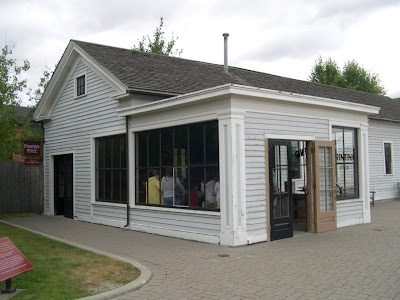
Printing Office and Tin Shop (formerly known as Print Shop and Village Print Shop)

Image
The Printing Office: Built inside the Village in 1933, half of this building is a printing shop, and the other half is a tinsmith shop. In the print shop, a variety of presses are demonstrated, from early powered presses to a hand press. The presenter sets the type to show the patrons how printing was done in the days before automation, including the typesetting of the letters and woodcuts. Using the hand press, the visitor can see how the early papers were printed by hand. In our modern age of instant information via phone, home computer, radio, and other electronic sources band devices, many of the folks today - especially school age children - do not realize how important the occupation of printing was to the towns and villages of the 19th century, in many cases the only source of news of the outside world. The Tin Shop: The tinsmith made lanterns, candleholders, and household utensils from the 17th through the early 20th century. Called the poor man's silver, all that was neede...

Bagley Avenue Workshop (formerly known as 58 Bagley Avenue Shop, and 58 Bagley Avenue Shed)

Image
In 1893, Henry Ford and wife Clara moved into a rented house at 58 Bagley Avenue. At that time, Ford was an engineer for the Edison Illuminating Company of Detroit. This replica of the Detroit Shed/workshop that was located in the backyard of the home where Ford built his first car in 1896 was constructed inside the Village in 1933, although, in many ways, it is not totally a replica. To get his Quadricycle out of the shed, Ford had to knock out the bricks around the doorway. Although the original shed was torn down some years after, Ford located the house in which the bricks and doors had been used. By building a new wall for the owners of the house, Ford was allowed to remove the old shed bricks and doors for his reconstruction. A replica of the Quadicycle sits inside the shed. The original 1st auto by Ford is inside of the Henry Ford Museum. .

Edison Homestead

Image
When the grandfather of Thomas Edison led his family into Upper Canada in 1811, he settled in Vienna, Ontario, near the shore of Lake Erie. In 1816, their log cabin was replaced by this homestead, the first and for many years the only frame structure in that region. In this home, the father of the great inventor, Samuel, grew to manhood, and married Nancy Elliot, the village school teacher, in the Sunday parlor in 1828. When his arrest was sought because of his participation in the political rebellion of 1837, the house was ransacked by the military. By that time, Samuel Edison had fled to the United States. Young Tom had returned to his ancestral home over many summers and fondly recalled the large, simple, farm-type kitchen. It was moved to Greenfield Village in 1933. For some reason, the folks at the Village seem to want to show this house as it looked in 1915 - 99 years after it was originally built. But, even of that 1915 era shown, they have done a tremendous job in thei...

Plympton Family Home (formerly known as Plympton House)

Image
The brick over the large fireplace of the Plympton house dates to 1640, to the original home of Thomas Plympton. Plympton was a founding father of the Puritan settlement of Sudbury, Massachusetts, and lived there with his wife, Abigail, and their seven children. This, after he came to North America from England as an indentured servant. According to the 1941 guidebook, Plympton was slain by Indians in 1676, but his descendants, including a Thomas Plympton who actively took part in the American Revolution, continued to live in this one room home. The original house of the 1st Thomas Plympton burned down in the early 1700's, and the generation of the family who were living there at the time rebuilt the home around the original chimney. It is considered to be the oldest American home in Greenfield Village. An unusual feature in this home is the convenient inside covered well, seen to the left of the ladder. Most wells, during this period in time, were outside the home. This primitive ...

Owl Night Lunch Wagon

Image
According to the book, "American Diner Then and Now" by Richard Gutman, the Owl Night Lunch Wagon, acquired in dilapidated condition in 1927 and restored to its reconstructed glory shortly after, is the only remaining horse-drawn lunch wagon. It is a very good example of "fast food" from the 19th and early 20th centuries. According to a Ford cousin, Ford Bryan, in his book "Clara: Mrs. Henry Ford," Henry Ford patronized the Owl Night Lunch Wagon during his years working at Edison Illuminating. It was pulled to and from the curbside at Michigan and Griswold streets in Detroit by Reddy the bay horse, owned by John Colquhoun. It opened at 6 p.m. and left at daybreak - this at a time when restaurants in Detroit closed up by 8 p.m. There were originally stools inside the wagon and a window for take-out service. This 1890's diner was originally placed inside the Village in 1933, serving hamburgers to those first patrons of the Village. It was then moved insi...